
Article Summary:
- Larvicides for mosquito control target mosquito larvae in standing water before they develop into biting adults.
- Applying larvicides early in the season can reduce mosquito populations at the source, lowering disease risk for a community.
- A targeted larviciding approach also reduces the need for large-scale adult mosquito treatments.
- The most effective larvicide programs pair surveillance data with mapped, site-specific applications and ongoing monitoring, rather than a single treatment.
Larvicides for mosquito control are products applied directly to standing water to kill mosquito larvae before they mature into biting, potentially disease-carrying adults. Because every adult mosquito starts life in water, targeting the larval stage is one of the most efficient ways a community mosquito management program can reduce mosquito populations — and it’s most effective during the early season, before the first generation of adults ever takes flight.
What is the benefit of applying larvicides early in the season?
Early-season larvicide application kills mosquito larvae in standing water before they become biting adults, reducing overall mosquito populations, lowering disease risk, and reducing the need for costly adult mosquito treatments later in the year.
Why Does Larval Control Come Before Adult Control?
Treating mosquitoes at the larval stage is more effective than treating adults after they’ve already emerged. Larvae are concentrated in known, mapped water sources, so larvicide applications can precisely control mosquitoes where they breed, rather than wherever they’ve already spread.
That precision is also what makes larval control the foundation of an Integrated Mosquito Management (IMM) program: it works in conjunction with surveillance, public education, and adult control rather than replacing any of them.
A community that leads with larval control typically needs less adult treatment overall, which reduces the environmental footprint and lowers costs.
What Types of Larvicides Are Used for Mosquito Control?
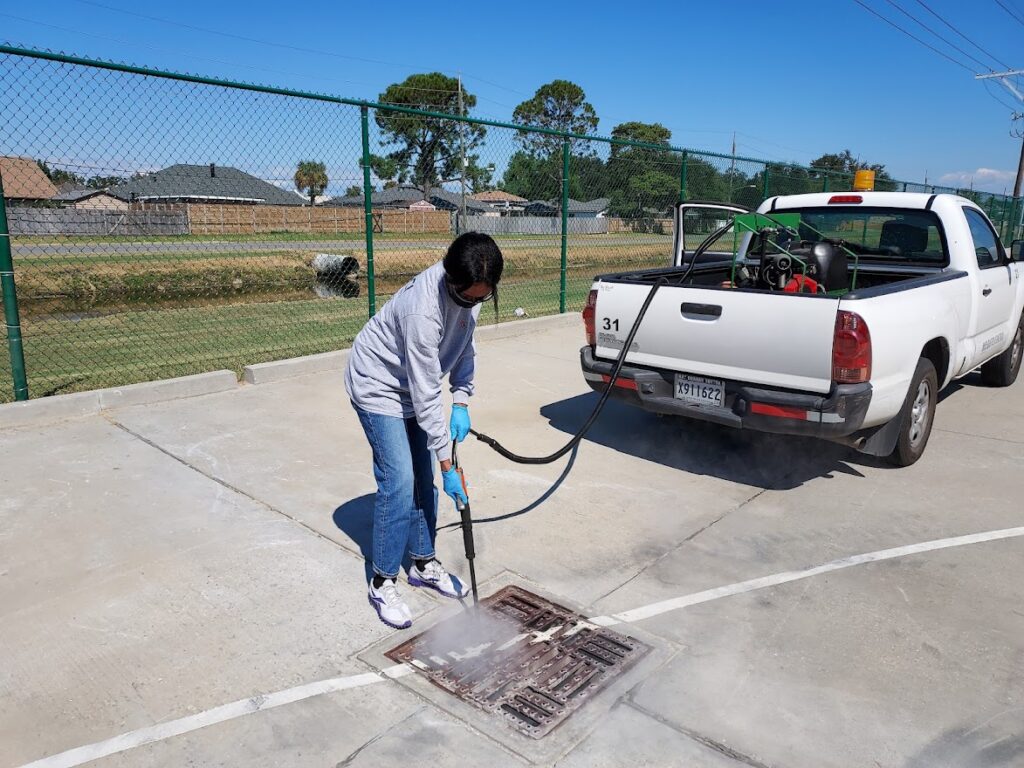
Not every water source calls for the same product. Utilizing the most effective larvicide for a water site is part of what makes a program effective rather than wasteful.
- Bacterial larvicides (such as Btis) use naturally occurring bacteria that target mosquito larvae specifically, with minimal impact on other aquatic life — a common choice for sensitive or public-facing water bodies, and one the CDC recognizes as a low-risk control option when applied correctly.
- Insect growth regulators (IGRs) disrupt the larvae’s ability to develop into adults, offering longer-lasting control in sites that are hard to revisit frequently.
- Surface oils and monomolecular films work by affecting the water’s surface tension, making it difficult for larvae and pupae to breathe — useful in stagnant, low-flow water.
Which option fits best depends on water flow, surrounding vegetation, the species of mosquito, and how sensitive the surrounding environment is, which is why site-specific assessment matters as much as the larvicide itself.
This is where an experienced mosquito management partner like VDCI adds value. Our field teams individually assess each site’s conditions and match the right product to it, rather than applying a one-size-fits-all treatment.
How Do You Build an Early-Season Larvicide Strategy?
An effective early-season strategy isn’t a single application. Instead, it’s a four-step process, done in order and repeated throughout the season.
Why Start With Surveillance Data?
Before larvicide ever touches water, a program needs to know where mosquitoes are breeding. Ongoing surveillance and mapping, such as tracking standing-water sites, identifying mosquito species, and monitoring population trends, support larviciding as a targeted, defensible decision rather than a mere guess.
Why Map High-Risk Water Sources Early in the Season?
Catch basins, roadside ditches, retention ponds, and other standing water areas should be identified and prioritized before mosquito season ramps up. Early mapping ensures treatment can begin as soon as larvae are active, rather than after the first wave of adult mosquito complaints.
How Do You Match a Larvicide Product to the Site?
Water flow, vegetation, and the mosquito species present all inform which product and application method will be most effective — and most environmentally responsible — for a given location:
- Fast-moving drainage ditches need a different approach than still, vegetated retention ponds.
- Dense urban neighborhoods hide cryptic breeding sites — clogged gutters, backyard containers — that are hard to reach on foot, and door-to-door inspection strains a program’s budget and staffing.
- Truck-based wide-area application extends a larvicide’s reach into backyard habitats ground crews would otherwise miss, cutting down on labor-intensive hand treatments.
Why Does Ongoing Monitoring Matter All Season?
Larval control isn’t solely a one-time treatment. Ongoing monitoring confirms whether an application is working and signals when a site needs to be revisited, maintaining a proactive program rather than a reactive one, in line with the EPA’s guidance on mosquito control.
What Happens If You Skip Early-Season Larval Control?
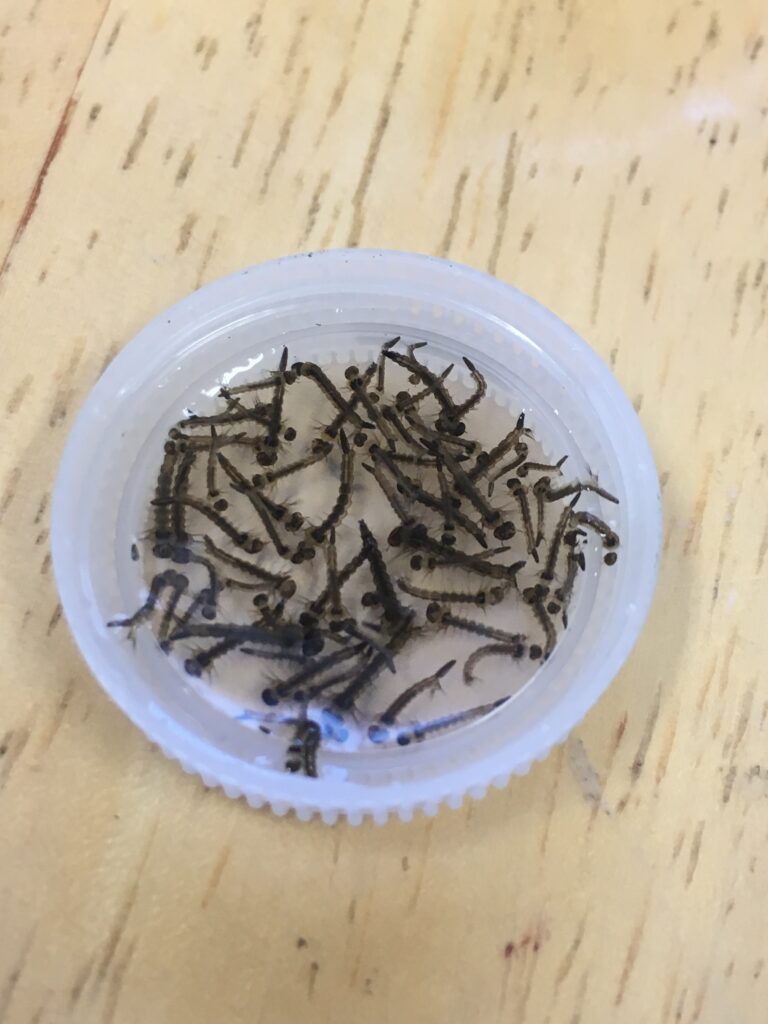
Skipping or delaying larvicide application allows the first generations of mosquitoes to develop to adulthood unchecked. Consequently, this results in more biting adults circulating earlier in the season, a higher disease risk for residents, and a greater reliance on large-scale adult treatments, which increases costs and reaches fewer mosquitoes at their true source. It also puts a program in a reactive posture for the rest of the season, chasing adult populations instead of managing them at the source.
How Does Larval Control Fit Into a Broader Mosquito Management Program?
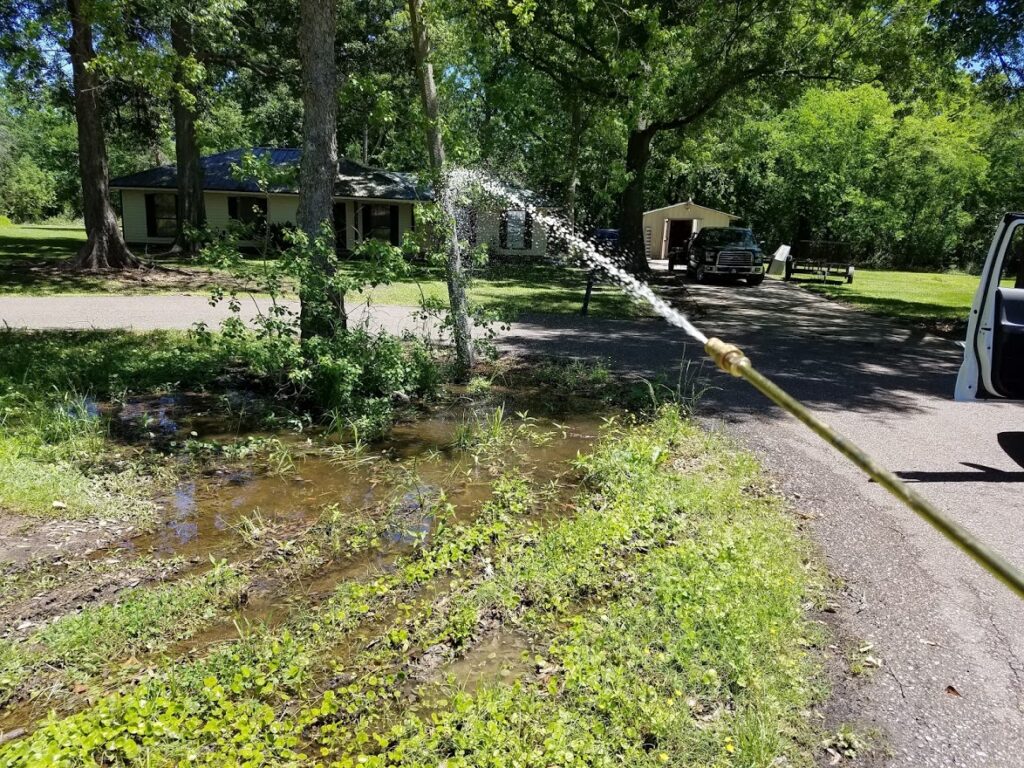
Larvicides are one layer of a larger mosquito management system, not a standalone fix. A mature mosquito control program pairs ongoing source-based larval control with public education, disease surveillance and testing, and adult control, so no single tactic bears the entire burden.
A multi-faceted approach is also easier to explain to residents and local officials, as a program that’s visibly proactive and data-driven builds more public trust than reactive spraying alone. This is important as statistics show mosquito management programs that are supported by the public and incorporate regular public outreach initiatives are more effective.
Key Takeaways
- Larvicides for mosquito control target larvae in standing water before they develop into biting, disease-carrying adults.
- Early-season application reduces mosquito populations at the source and, in turn, lowers community disease risk.
- Different larvicide types, such as bacterial, growth regulators, and surface films, serve different water sources and scenarios.
- Surveillance data and site mapping should precede any larvicide application.
- Ongoing monitoring keeps a larval control program proactive rather than reactive.
Planning an early-season larvicide strategy is just one component of a comprehensive mosquito management program, and it’s where VDCI’s Integrated Mosquito Management approach starts.
Our teams combine surveillance and disease testing, source-based larval control, adult control, and public education so communities receive a program that’s proactive, science-based, and built to withstand public scrutiny.
If your community is ready to plan its early-season mosquito strategy, request a consultation with our team today.

Contact Our Experts
Complete the form below or call us at 800-413-4445 to speak to an expert about your mosquito management needs.
 Since 1992, Vector Disease Control International (VDCI) has taken pride in providing municipalities, mosquito abatement districts, industrial sites, planned communities, homeowners associations, and golf courses with the tools they need to run effective mosquito control programs. We are determined to protect the public health of the communities in which we operate. Our mosquito control professionals have over 100 years of combined experience in the field of public health, specifically vector disease control. We strive to provide the most effective and scientifically sound mosquito surveillance and control programs possible based on an Integrated Mosquito Management approach recommended by the American Mosquito Control Association (AMCA) and Centers for Disease Control and Prevention (CDC). VDCI is the only company in the country that can manage all aspects of an integrated mosquito management program, from surveillance to disease testing to aerial application in emergency situations.