

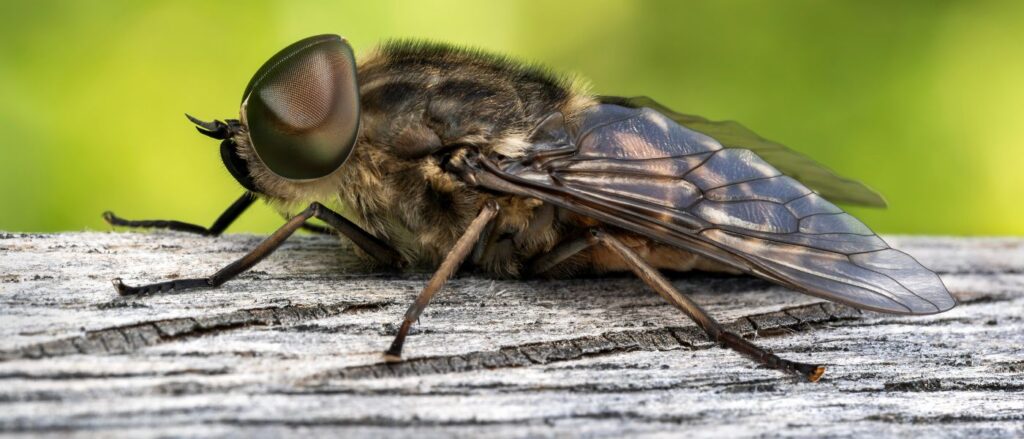

Scientists have debated the question for decades, but research increasingly points to an intriguing possibility: those bold patterns can make it harder for blood-feeding flies, such as horseflies, to successfully land.
A growing body of peer-reviewed research shows that high-contrast striped patterns strongly deter tabanid horseflies and other blood-feeding flies. In experiments comparing zebras with uniformly colored horses, far fewer flies successfully landed on striped surfaces, suggesting that the stripes evolved – at least in part – as a defense against parasites that can cause blood loss and transmit disease.
How Do Zebra Stripes Deter Biting Flies?
But the really interesting question is how the stripes work. Studies tracking horsefly flight behavior found that flies approaching zebras often failed to slow down and make a controlled landing, instead flying past or briefly touching the animal.
Experiments with striped coats also found that flies avoided strongly contrasting stripes, while more recent work found that even complex striped and checked patterns interfere with successful landings. These results point toward a disruption of the fly’s close-range visual targeting and landing behavior.
The evidence isn’t limited to captive experiments. In a 2022 field study in Kenya, researchers released hungry Stomoxys biting flies around zebra and impala pelts. The flies strongly preferred the uniform tan impala pelts over the striped zebra pelts, confirming that zebra striping can repel biting flies under relatively natural conditions.
The exact evolutionary story is still being worked out, but the evidence increasingly suggests that those iconic black-and-white stripes are less about camouflage or predators—and more about making a zebra a frustrating target for blood-feeding insects.

KEY TAKEAWAY:
Research suggests that zebra stripes help reduce biting-fly landings by interfering with close-range approach and landing behavior.
How Do Visual Patterns Affect Mosquitoes?
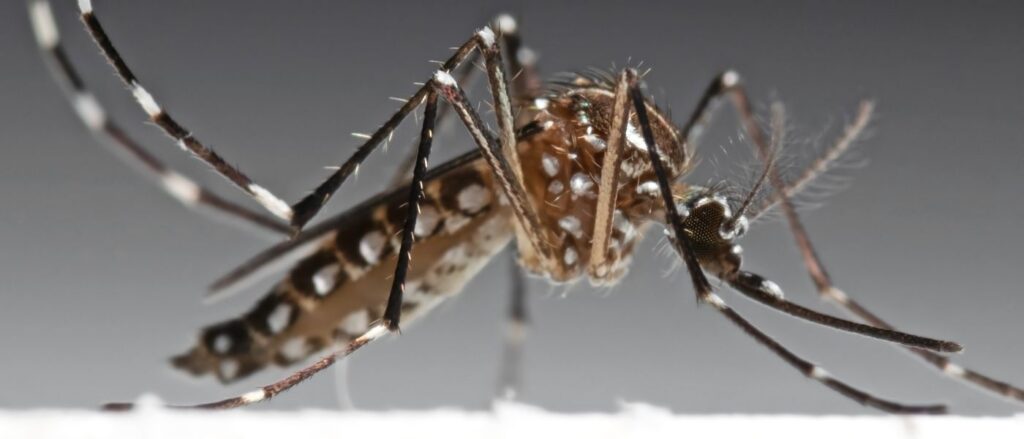
When we think about mosquitoes, vision is an important part of the host-seeking process, working alongside cues such as carbon dioxide, heat, and odor to help them locate a potential blood meal. This makes patterns particularly interesting for mosquito research and control.
In a semi-field study of Aedes aegypti, researchers compared host-decoy traps with solid black, solid white, black-and-white striped, and checkerboard surfaces. The solid black trap captured significantly more mosquitoes than the patterned surfaces, showing that changing a trap’s visual appearance can change its performance. In other words, mosquito behavior isn’t just about smell and heat; visual design matters too.
Moreover, while stripes have been shown to influence host-seeking behavior among mosquitoes, the same may hold true for where mosquitoes lay their eggs. Studies have shown black and white stripes may deter mosquitoes from potential oviposition sites.
Field studies in Florida demonstrated Aedes albopictus preferred solid black and blue cups for oviposition sites compared to those with stripes or checkered patterns. Demonstrating visual cues are not just used for seeking out hosts but for oviposition as well.

KEY TAKEAWAY:
Research on egg-laying preferences suggests that container color and pattern can influence where certain mosquitoes lay their eggs.
How Mosquito Behavior Informs More Targeted Management
The study of how mosquitoes interact with their environment highlights the importance of understanding their complex behaviors and unique adaptive strategies. As mosquitoes continue to evolve and respond to environmental pressures, our ability to anticipate their movements becomes critical. By integrating these behavioral insights into broader management efforts, we can develop smarter surveillance tools and more targeted control strategies that better mitigate populations and protect public health.
This blog was written by Dr. Broox Boze, Director of Technical Services for VDCI, and Dr. Peter Obenaur, Medical Entomologist and Technical and Training Manager for VDCI. Dr. Boze holds a Ph.D. from Colorado State University and has extensive experience coordinating mosquito surveillance, management, and emergency response operations in the U.S. and internationally. Dr. Obenaur brings more than 25 years of experience in preventive medicine, public health entomology, mosquito surveillance, technical writing, and operational vector-borne disease control.

Contact Our Experts
Complete the form below or call us at 800-413-4445 to speak to an expert about your mosquito management needs.
Since 1992, Vector Disease Control International (VDCI) has taken pride in providing municipalities, mosquito abatement districts, industrial sites, planned communities, homeowners associations, and golf courses with the tools they need to run effective mosquito control programs. We are determined to protect the public health of the communities in which we operate. Our mosquito control professionals have over 100 years of combined experience in the field of public health, specifically vector disease control. We strive to provide the most effective and scientifically sound mosquito surveillance and control programs possible based on an Integrated Mosquito Management approach recommended by the American Mosquito Control Association (AMCA) and Centers for Disease Control and Prevention (CDC). VDCI is the only company in the country that can manage all aspects of an integrated mosquito management program, from surveillance to disease testing to aerial application in emergency situations.
