
How Artificial Intelligence Is Reshaping Mosquito Control

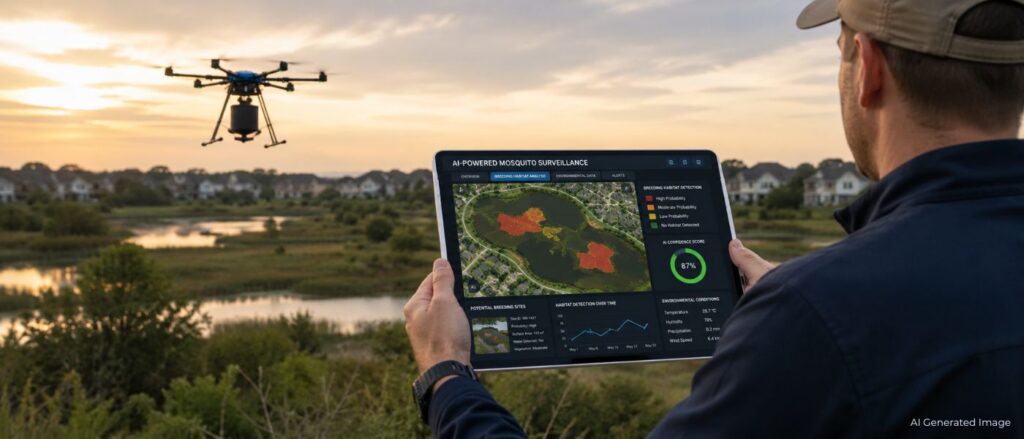
image showing a mosquito technician holding a tablet depicting a mosquito surveillance map and a drone in the sky - vdci - ai generated image

And Why Human Expertise Matters More Than Ever

Artificial intelligence is already becoming deeply woven into modern society. It’s transforming industries, changing how businesses operate, and reshaping the way people interact with technology in daily life. Mosquito control is no exception.

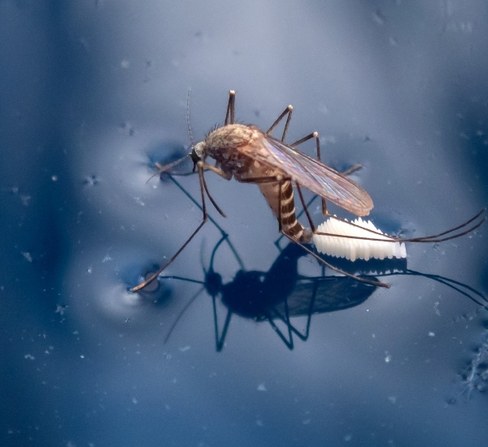
Across the globe, researchers, public health agencies, universities, and private businesses are exploring how AI can help combat one of the world’s oldest and deadliest threats―mosquitoes. Mosquitoes are responsible for transmitting mosquito-borne diseases that affect millions of people every year, including malaria, dengue, Zika, chikungunya, West Nile virus, and yellow fever. According to the American Mosquito Control Association, mosquito-borne diseases contribute to more than one million deaths annually.(1)

Why AI Is Gaining Attention in Mosquito Control

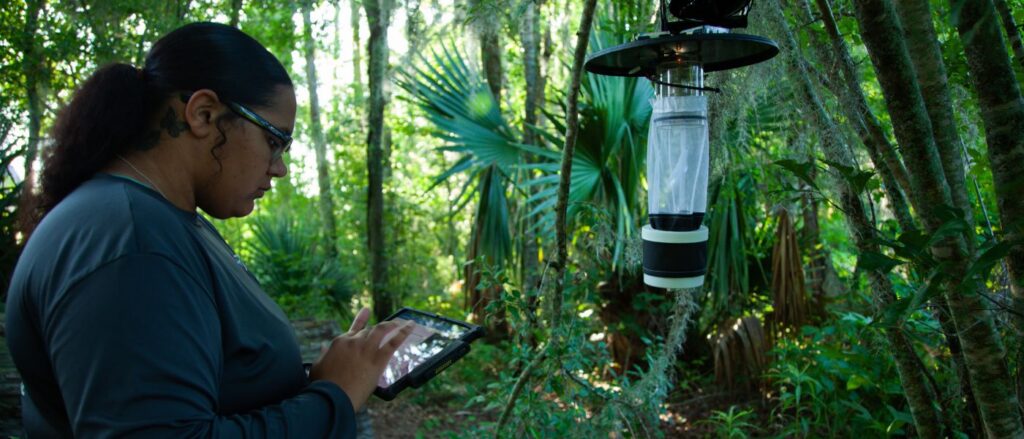
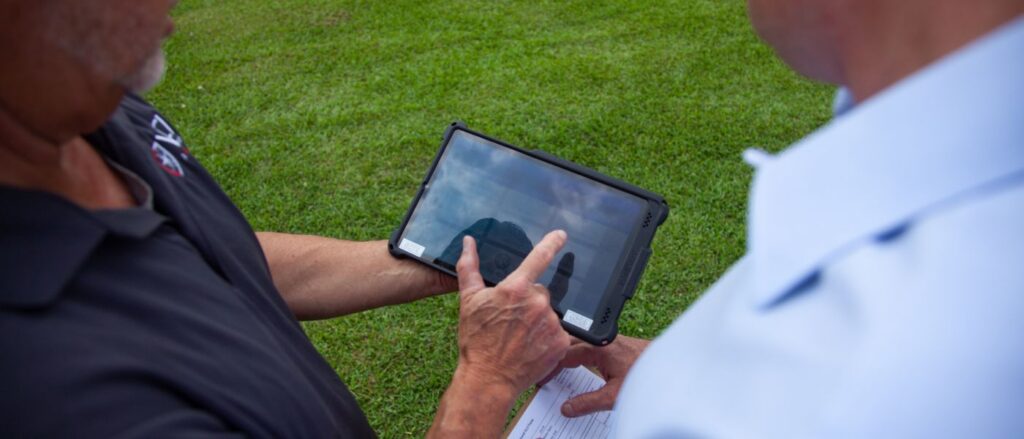
mosquito expert reviewing surveillance data on tablet

Mosquito control is becoming more complex every year. Climate change is contributing to longer mosquito seasons. Increased global trade and travel are accelerating the spread of different mosquito species into previously unaffected areas. Insecticide resistance continues to erode the effectiveness of traditional control strategies.

With this in mind, it’s easy to understand why AI has garnered so much attention. Yet, despite many futuristic headlines, the reality is more nuanced. The most important role of AI is not replacing mosquito control professionals or autonomously eliminating mosquitoes. Instead, AI may help experts work smarter by improving mosquito surveillance, identifying high-risk areas, optimizing management strategies, and processing enormous amounts of data more quickly.

Smart Species Identification

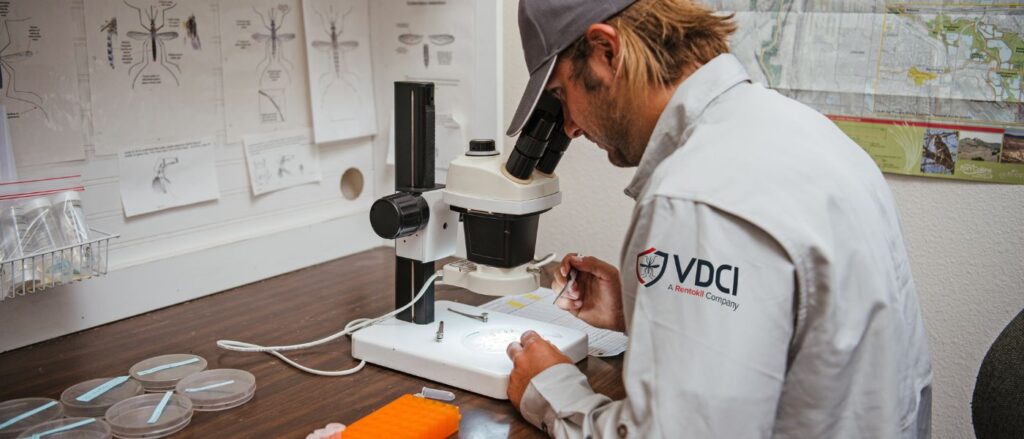
lab technician conducting mosquito species identification under microscope

Not all mosquitoes pose the same public health risks. Some species are highly efficient disease vectors; others pose smaller risks or don’t bite humans at all. By assessing the mosquito species present in a given area, experts can better understand public health threats and make more informed management decisions. 

Traditionally, this process has involved manually examining mosquito samples under microscopes, which is a highly specialized and time-consuming task. AI-powered tools may help expedite this process. 

A handheld species identification device is being developed through research efforts associated with Johns Hopkins University.(2) It uses a smartphone, magnifying lens, lighting system, and machine learning software to review high-resolution images. The device can correctly determine:

  • The mosquito species with 94% accuracy
  • The mosquito’s sex with 98% accuracy
  • The mosquito’s abdominal status (whether it has recently fed or is in a reproductive stage) with 82% accuracy

This low-cost tool is not a replacement for highly trained entomologists. It’s designed specifically for use in field environments where knowledgeable experts may not always be available. In malaria-endemic regions like Uganda, rapid identification of the vector genus , Anopheles, can help guide interventions and community outreach campaigns before outbreaks intensify. 

Sterile Insect Technique (SIT)

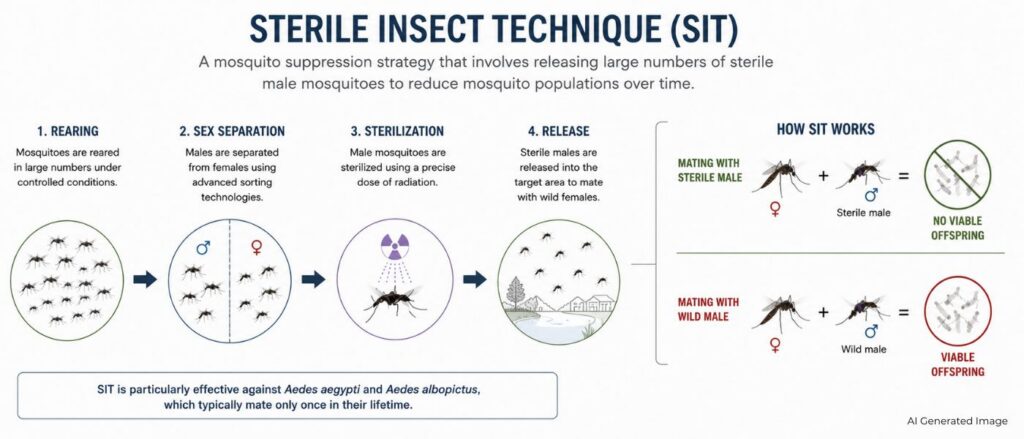
Image illustration depicting what Sterile Insect Technique (SIT) is- ai generated image

SIT is a mosquito suppression strategy that involves releasing large numbers of sterile male mosquitoes that do not bite or spread diseases. The technique is particularly effective against Aedes aegypti and Aedes albopictus females that typically mate only once during their lifetime; if she mates with a sterile male, no viable offspring are produced. While Culex and Anopheles mosquitoes also generally mate only once, evidence of females mating with multiple males is more common in these groups, which can affect SIT effectiveness.

Producing millions of mosquitoes, accurately separating males from females, sterilizing them, and effectively disseminating them is labor-intensive and logistically challenging. Some companies are applying machine learning and computer imaging technologies to analyze subtle anatomical differences between male and female mosquitoes and improve the speed and precision of the sorting process. 

The science behind SIT is not new, but it has struggled to scale for numerous reasons, including operational complexity, high risks of error, and lack of funding.(3)  

Acoustic Technology

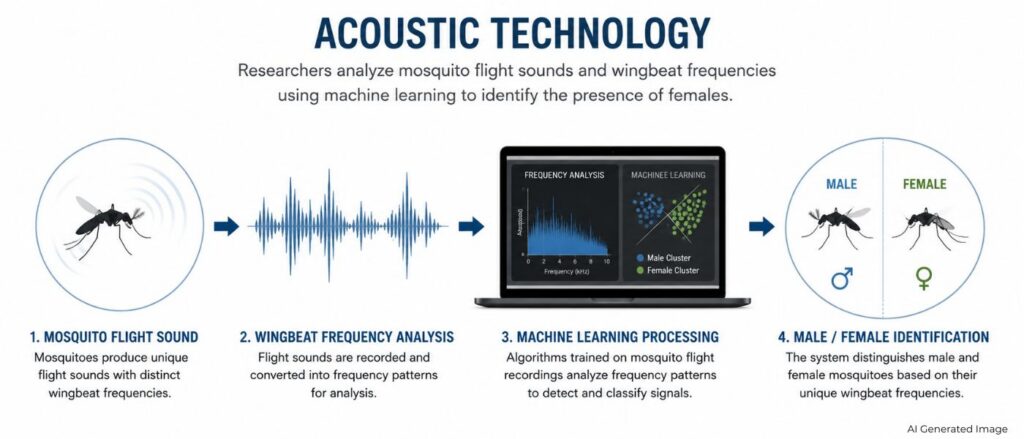
Image illustrating depicting what mosquito acoustic technology is - ai generated image

Researchers are working to develop AI systems that can distinguish male and female mosquitoes based on wingbeat frequencies and flight sounds. Using machine learning algorithms trained on mosquito flight recordings, these systems have demonstrated the ability to detect the presence of females inside mosquito release containers.(4)

However, while the technology is promising, it is greatly limited by a lack of standardization and access to consistent data.

Drone Imagery and AI-Powered Mosquito Surveillance

ai generated image showing a drone in the sky and a technician with a tablet showing how ai helps power mosquito surveillance - ai generated image

Commercial drones are already valuable tools in mosquito control because they allow professionals to survey inaccessible or dangerous areas safely and efficiently. Wetlands, flood-prone regions, retention ponds, dense vegetation, and environmentally sensitive habitats can be surveyed from above with far greater speed and precision than traditional ground inspections alone.

Researchers can now combine drone imagery with AI-powered analysis systems that are capable of identifying mosquito breeding habitats.

Projects Across Different Countries Point to the Technology’s Growing Potential

INDONESIA

In a study conducted in Indonesia, researchers used drone imagery and deep learning models to detect discarded tires in urban areas as part of efforts to identify breeding sites for Aedes aegypti, a primary vector of dengue, Zika, yellow fever, and chikungunya. 

Using high-resolution aerial images collected by local drone pilots, they trained convolutional neural networks to recognize tire shapes and patterns associated with mosquito habitat. The AI system identified nearly twice as many tires as human reviewers and was even able to detect tires partially submerged in water or hidden by vegetation and shadows.(5)

KENYA

Similar research in Kenya used aerial imaging and machine learning to map and classify trash piles in communities at high risk for dengue and chikungunya transmission. Drone imagery was combined with ground inspections to assess waste sites based on their potential to serve as mosquito breeding habitats. Each site was then categorized as high, medium, low, or no risk based on factors such as water retention, density, surface area, and surrounding environmental conditions.

The results were promising:

  • Drone image analysis identified 1.8 to 4.4 times more trash sites than traditional walking surveys.
  • When compared with ground validation, 94% of UAV-identified trash sites were correctly located and properly classified.
  • The system correctly avoided 98% of “trash mimics” (objects that could be mistaken for trash during ground surveys).(6)

INDIA

Some governments are already beginning to pilot large-scale AI-assisted mosquito surveillance systems. In India, the state of Andhra Pradesh recently announced the development of the Smart Mosquito Surveillance System (SMoSS), a technology-driven program that integrates AI-powered sensors, drones, environmental monitoring systems, and automated alerts.(7)

The system is designed to monitor mosquito species, population density, environmental conditions, and potential outbreak risks in real time. Alerts are triggered when mosquito activity exceeds predefined action thresholds, enabling rapid, targeted intervention.

Why Human Expertise Still Leads Integrated Mosquito Management

consider-sustainable-mosquito-control-strategies-to-protect-public-health-vdci

Despite the excitement surrounding AI, it is important to separate true innovation from exaggerated headlines. Machine learning cannot replace the experience, judgment, and community engagement provided by mosquito control experts. These systems are only as reliable as the data they receive, and many models perform far better in controlled research settings than they do in complex real-world environments.

AI can help process surveillance data, identify potential breeding sites, and improve operational efficiency, but it cannot fully account for changing weather, human behavior, infrastructure challenges, or the adaptability of mosquitoes themselves. Entomologists play vital roles in validating data, interpreting environmental conditions, and determining the most effective management approach for each unique situation. 

This is especially important for Integrated Mosquito Management (IMM) programs, which require far more than simply identifying mosquitoes or conducting treatments. Effective IMM strategies involve balancing public health priorities, scientific evidence, regulatory requirements, operational capacity, and environmental considerations.

Successful mosquito control programs also depend on professionals who can build relationships, establish trust, and maintain open communication in the communities they serve. That kind of local engagement and human connection takes time, experience, and empathy that AI simply cannot replace.

YouTube player

Contact Our Experts

Complete the form below or call us at 800-413-4445 to speak to an expert about your mosquito management needs.
VDCI_Logo_squareSince 1992, Vector Disease Control International (VDCI) has taken pride in providing municipalities, mosquito abatement districts, industrial sites, planned communities, homeowners associations, and golf courses with the tools they need to run effective mosquito control programs. We are determined to protect the public health of the communities in which we operate. Our mosquito control professionals have over 100 years of combined experience in the field of public health, specifically vector disease control. We strive to provide the most effective and scientifically sound mosquito surveillance and control programs possible based on an Integrated Mosquito Management approach recommended by the American Mosquito Control Association (AMCA) and Centers for Disease Control and Prevention (CDC). VDCI is the only company in the country that can manage all aspects of an integrated mosquito management program, from surveillance to disease testing to aerial application in emergency situations.

Vector Mosquito Control Beyond the Backyard

Vector Mosquito Control vs Backyard Efforts Alone

Beyond the Backyard: Community-Wide Vector Mosquito Control That Protects Public Health

Backyard prevention plays an important role in mosquito management and protecting public health. Simple actions such as eliminating standing water, applying repellents, and limiting outdoor exposure during peak mosquito hours can help reduce mosquito activity around the home and your chances of getting bitten. However, managing mosquito populations effectively often requires more than actions on a single property.

Vector mosquito control programs take a broader view by monitoring mosquito activity across neighborhoods, identifying which mosquito species are present, and adjusting control strategies based on surveillance data. This coordinated approach helps communities manage nuisance and potentially disease-carrying mosquitoes more effectively over time.

Why Does My Backyard Mosquito Problem Keep Coming Back?

Because mosquitoes don’t respect property lines.

If you’re wondering how to reduce mosquitoes outside your home, you’re not alone. But even the most diligent property owner cannot fully manage mosquito populations alone. Many mosquito species can travel significant distances from where they hatch. Some can fly up to several miles in search of a blood meal.

Mosquitoes are not restricted to one yard. If they’re developing in a storm drain or a retention pond nearby, once they become adults, they will fly and cover a larger area. A single unmanaged mosquito breeding spot can influence what people experience across a block. And while a short-term effort might reduce biting for a while, it doesn’t change the fact that new mosquitoes are still emerging from surrounding areas. Managing them usually involves looking beyond individual properties.

What Is Vector Mosquito Control and Why Does It Matter for Public Health?

Vector mosquito management is the coordinated action to reduce mosquitoes capable of transmitting diseases to people or affect quality of life when populations become abundant. 

Not all mosquitoes transmit diseases. However, certain species can transmit viruses such as West Nile virus, Eastern Equine Encephalitis (EEE), dengue, and others.

Municipal mosquito vector control programs focus on:

  • Identifying which mosquito species are present
  • Monitoring mosquito population levels
  • Testing mosquitoes for disease
  • Implementing targeted control efforts based on scientific data

This science-based approach reduces nuisance and potentially disease-carrying mosquitoes while supporting long-term public health goals.

You can learn more about common vector-borne diseases on VDCI’s vector-borne diseases resource page.

Why Mosquito Management Goes Beyond the Backyard?

Backyard prevention is only part of the picture.

Many communities encourage residents to follow the “4 Ds”:

  • Dump standing water
  • Dress in light-colored, long sleeves, and pants
  • Defend yourself with EPA-approved repellents
  • Avoid Dawn and Dusk, when many mosquitoes are most active

The following steps can assist with reducing mosquito breeding sites around the home and help protect you from bites. While many mosquitoes develop in backyards, they also breed in storm drains, retention areas, roadside ditches, and other community spaces. Even when individual properties are well-maintained, mosquitoes can travel in from nearby locations. That’s why mosquito management is best addressed at the community level, not property by property.

When municipalities implement Integrated Mosquito Management (IMM) programs, they combine: 

  • Surveillance and disease testing
  • Larval mosquito management
  • Targeted adult mosquito management when necessary
  • Ongoing public education

This layered strategy addresses mosquito populations at multiple life stages rather than focusing solely on adult mosquitoes.

For a deeper look at how IMM works, visit VDCI’s guide to the four pillars of an effective mosquito management program.

Understanding the Risks of DIY Mosquito Spraying

Some homeowners turn to backyard mosquito sprays for quick relief from mosquitoes. While certain EPA-registered products can provide a temporary reduction in mosquitoes, frequent or uncoordinated spraying can create unintended challenges.

Repeated insecticide use without surveillance data can contribute to insecticide resistance, meaning mosquito populations may become less responsive to those products over time. When resistance develops, it can challenge many mosquito management programs to control populations when targeted interventions are required.

That’s why professional mosquito management programs regularly monitor local mosquito populations for resistance through diagnostic testing to ensure control applications are effective. If resistance is detected, experts can make adjustments to products and application techniques to maintain successful control.

How Does Integrated Mosquito Management (IMM) Reduce Disease Risk?

Integrated Mosquito Management (IMM) reduces public health risk by prioritizing proactive, data-driven decision-making to reduce the spread of mosquito-borne diseases. The Centers for Disease Control and Prevention (CDC) states that effective mosquito control programs combine surveillance, source reduction, larval management, and targeted adult management to responsibly reduce mosquito populations.

IMM programs do not rely on one-time actions. Instead, they:

  1. Collect Data First
    Traps are used to monitor mosquito species, density, and distribution. Lab testing determines whether viruses are present in local populations.
  2. Target Mosquitoes Early
    Larval mosquito management addresses mosquitoes in standing water before they emerge as adults.
  3. Use Targeted Adult Management When Needed
    When surveillance data shows elevated populations or disease risk, targeted adult mosquito management may be implemented.
  4. Educate the Public
    Ongoing communication helps residents understand their role in mosquito management and how they can protect themselves, which helps build transparency and trust around municipal actions.
The balance between reactive and proactive mosquito control measures is what distinguishes professional mosquito vector control from isolated backyard efforts.

What is vector mosquito control, and why does it support backyard efforts?

When people think about mosquito control, they usually picture what happens in their own yard. But local governments take a much broader view. They track mosquito activity across neighborhoods, identify which species are present, and adjust their approach as conditions change. Since mosquitoes don’t stay within property lines, efforts that cover an entire community generally have a greater impact than work done on one lot at a time.

What Should Municipal Leaders Consider?

Municipal decision-makers—such as commissioners, public works directors, and health officials—who want to determine if their mosquito management program is set up for success should evaluate whether their community’s approach is:

  • Data-driven rather than complaint-driven
  • Proactive rather than reactive
  • Transparent and education-focused
  • Aligned with environmental best practices

A comprehensive mosquito vector control strategy is not about eliminating every mosquito. It’s about managing populations responsibly to reduce nuisance and public health risk.

Key Takeaways

  • Vector mosquito control is most effective when implemented as a coordinated, community-wide effort.
  • Backyard actions support public health—but they cannot replace coordinated mosquito vector control programs.
  • Integrated Mosquito Management (IMM) combines surveillance, larval control, targeted adult management, and public education.
  • Proactive, data-driven programs reduce long-term nuisance and disease risk more effectively than one-time fixes.
  • Municipal leadership plays a critical role in protecting communities from nuisance and potentially disease-carrying mosquitoes.

When communities invest in long-term surveillance and integrated planning, they’re better equipped to manage nuisance and potentially disease-carrying mosquitoes responsibly. Connect to learn more about how these programs are designed.


YouTube player

Contact Our Experts

Complete the form below or call us at 800-413-4445 to speak to an expert about your mosquito management needs.

VDCI_Logo_squareSince 1992, Vector Disease Control International (VDCI) has taken pride in providing municipalities, mosquito abatement districts, industrial sites, planned communities, homeowners associations, and golf courses with the tools they need to run effective mosquito control programs. We are determined to protect the public health of the communities in which we operate. Our mosquito control professionals have over 100 years of combined experience in the field of public health, specifically vector disease control. We strive to provide the most effective and scientifically sound mosquito surveillance and control programs possible based on an Integrated Mosquito Management approach recommended by the American Mosquito Control Association (AMCA) and Centers for Disease Control and Prevention (CDC). VDCI is the only company in the country that can manage all aspects of an integrated mosquito management program, from surveillance to disease testing to aerial application in emergency situations.